+86-579-87217855
 ykdc@dingchuncup.com
Choose Responsibility Choose Dingchun
-BSCI Certified S/S Tumbler


-BSCI Certified S/S Tumbler
Nov 06,2026
The steel grade used in an insulated straw mug is easy to overlook when comparing products, but it has a lasting effect on how the mug performs. It influences how easily the body can be formed, how well the surface resists corrosion, and whether the finished product holds up to regular use. A material that looks fine on the production line may not be suitable once the mug is exposed to drinks, washing, and everyday handling.
For manufacturers, the inner liner and outer shell do not necessarily need to use the same grade. Their jobs are different, and choosing materials separately can help balance product performance and manufacturing cost.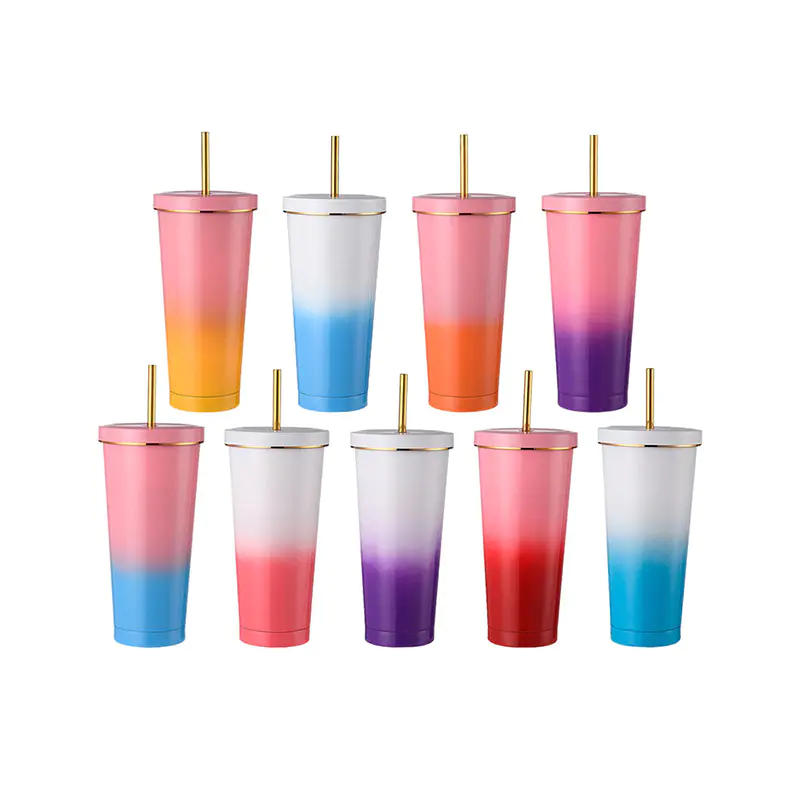
Why Stainless Steel Is Commonly Used for Insulated Straw Mugs
Take apart a typical vacuum-insulated straw mug and you will find an inner liner, an outer shell, and a sealed space between them. The lid and straw complete the assembly. The vacuum layer slows heat transfer through conduction and convection, while the two steel walls provide the structure.
Stainless steel is a practical choice for this construction. It has the strength needed for a reusable body and can be formed into the shapes commonly used in drinkware. It also offers resistance to corrosion from normal beverage contact.
The grade still matters, though. A mug body has to go through forming, trimming, welding, polishing, and vacuum sealing. Material that performs well in use must also be workable during production.
Compare 304 and 316 Stainless Steel for the Inner Liner
304 and 316 are both widely used austenitic stainless steels, but they do not offer exactly the same corrosion resistance.
304, often referred to as 18/8 stainless steel, contains approximately 18% chromium and 8% nickel. It is commonly used for drinkware because it offers a useful combination of corrosion resistance, formability, and weldability.
316 contains molybdenum in addition to chromium and nickel. That addition improves resistance to certain corrosive conditions, particularly those involving chlorides. It may be worth considering for premium products or applications where exposure conditions are more demanding. Its higher cost, however, is not necessarily justified for an everyday straw mug.
| Material | Main characteristics | Typical suitability |
|---|---|---|
| 304 stainless steel | Good corrosion resistance, formability, and weldability | Standard inner liners and outer shells |
| 316 stainless steel | Enhanced resistance to chloride-related corrosion | Premium drinkware and demanding environments |
| 201 stainless steel | Lower nickel content and generally lower corrosion resistance than 304 | Cost-sensitive applications with controlled use |
| 430 stainless steel | Ferritic grade with magnetic properties and moderate corrosion resistance | Selected outer-shell applications |
For many general-purpose mugs, 304 is sufficient for the inner liner. Moving to 316 makes more sense when the intended use creates a genuine need for its added corrosion resistance.
Select the Right Material for the Outer Shell
The outside of the mug has a different job. It does not normally touch the beverage, but it is exposed to knocks, scratches, fingerprints, and frequent handling. Its appearance also matters, particularly on products with painted or polished finishes.
304 is a common choice for outer shells because it forms well and provides good corrosion resistance. Some manufacturers use 201 or 430 for exterior components where controlling material costs is a priority. Whether this trade-off is worthwhile depends on the product's price range and expected service life.
One point worth checking during sourcing is the actual steel grade. A supplier description that simply says "stainless steel" does not tell buyers enough. Material certificates or appropriate verification records can help confirm what is being used.
Consider Formability, Welding, and Surface Finishing
A steel grade may look good on paper but cause problems during production. Mug bodies usually pass through several forming and finishing stages, and the material needs to handle each one without developing defects.
304 is generally suitable for deep drawing, which is why it is often used for cylindrical bodies and shaped drinkware components. 316 can also be formed, but its higher cost needs to be considered alongside the production requirements.
The factory process deserves a closer look:
Changing the steel grade will not correct poor manufacturing. Even good material can produce a weak or unreliable mug if the forming or welding process is poorly controlled.
Verify Food-Contact Safety and Corrosion Resistance
The steel body is only part of the finished drinkware. The lid, straw, silicone seals, coatings, and adhesives also come into contact with the product or its contents. Each may have separate material and compliance requirements.
OEM buyers should request documents identifying the stainless steel grade and showing compliance with the food-contact rules applicable to the destination market. Depending on where the mug will be sold, relevant requirements may include FDA rules in the United States or food-contact materials regulations in the European Union.
Actual use conditions should not be overlooked. Acidic drinks, salt-containing liquids, and aggressive cleaning chemicals can affect surface condition. Stainless steel resists corrosion, but that does not mean it is completely immune to staining or damage.
Balance Material Cost With Long-Term Product Quality
Choosing a lower-priced grade may reduce the initial material bill. That saving can disappear, however, if the material causes forming difficulties, increases rejection rates, or does not hold up as expected.
When reviewing suppliers, look at more than the quoted steel grade. Sheet thickness, dimensional tolerances, forming consistency, weld quality, and inspection records all affect the finished mug. Production samples are useful for checking the inner surface, exterior finish, lid fit, straw connection, and overall assembly.
For a standard product, a 304 liner with an appropriate outer-shell material may be entirely adequate. A 316 liner is worth considering when the product's intended use makes the extra corrosion resistance relevant. There is little reason to increase material cost without a clear benefit.
Choose Stainless Steel Based on the Product's Real Requirements
304 remains a common choice for insulated straw mug liners and outer shells because it is workable, corrosion-resistant, and widely used in drinkware production. 316 offers additional resistance in certain environments, while 201 and 430 may have a place in selected exterior components.
The grade should be chosen with the product design and factory process in mind, not simply because one material sounds more premium than another. Checking material records, food-contact documentation, and finished samples before mass production gives OEM buyers a more reliable basis for approving the final specification.
Your email address will not be published. Required fields are marked *



 +86-579-87217855
 ykdc@dingchuncup.com
 +86-579-87217600
 No.169 Yingbin Avenue, Industrial function zone, Xiangzhu Town, Yongkang Zhejiang, China.

OEM Thermos Mugs Manufacturer
 English
 Español
 عربى