 +86-579-87217855
 ykdc@dingchuncup.com
Choose Responsibility Choose Dingchun
-BSCI Certified S/S Tumbler


-BSCI Certified S/S Tumbler
Nov 13,2026
A 40oz tumbler holds plenty of coffee or water, but its size can become a problem inside a car. Many cup holders are designed for ordinary travel mugs, not tall, wide drinkware. A tumbler may fit the opening but sit too high, wobble when the vehicle turns, or get in the way of the gear selector.
For manufacturers, the difficult part is keeping the large capacity without making the lower body too bulky. Base diameter, taper, height, weight distribution, and handle position all need to be considered during product development.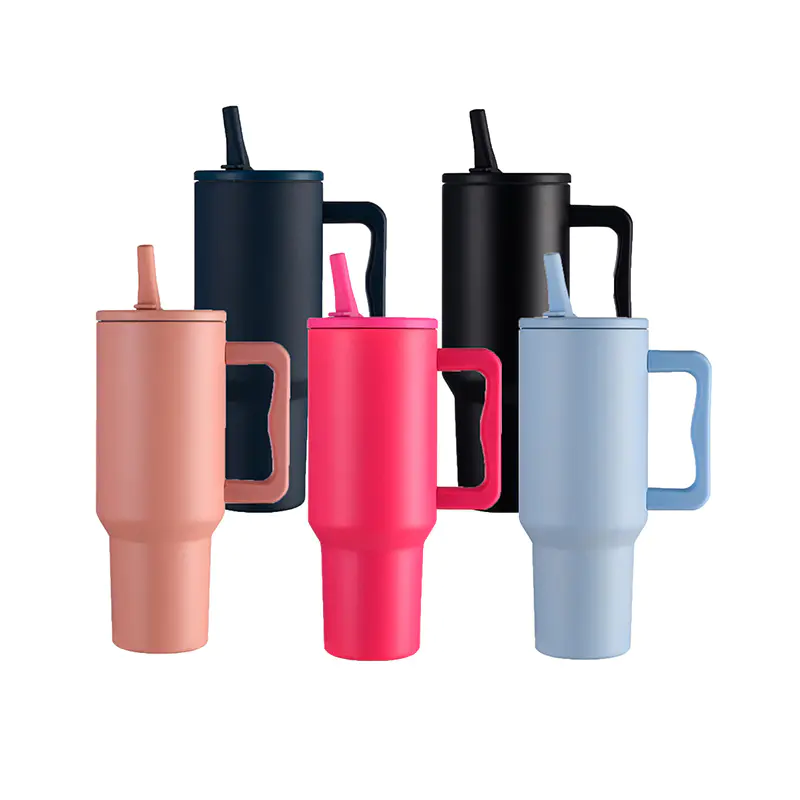
Start with Actual Cup Holder Dimensions
There is no universal cup holder size across cars and trucks. A center-console holder in a pickup may have more room than one in a compact sedan. Door-mounted holders and rear-seat holders can have different shapes and depths, even within the same vehicle.
Measuring the opening alone isn't enough. Some holders have retaining tabs, tapered walls, or a narrow bottom that affects how deeply a tumbler can sit.
During development, manufacturers should record:
Testing several vehicle types early can prevent expensive changes after the mold has been completed.
Design a Narrower Base Without Sacrificing Stability
A tapered bottom is commonly used to make large tumblers fit smaller cup holders. The upper body can remain wide enough to accommodate 40oz of liquid, while the lower section has a smaller diameter.
The challenge is finding the right transition between the two sections.
An excessively narrow base may fit more cup holders but leave the filled tumbler unstable. A base that is too short may also wobble in deeper holders, while an overly long one may not fit shallow designs.
The actual insertion depth should be checked alongside the diameter. Small changes to either dimension can make a noticeable difference in how securely the tumbler sits.
Use a Non-Slip Base to Reduce Movement
A metal tumbler sitting directly against a hard plastic cup holder can rattle when the vehicle moves. A silicone base or insert can reduce this noise and provide additional friction.
When choosing the material, consider its grip, abrasion resistance, and ability to withstand repeated temperature changes. It should also remain attached during regular insertion and removal.
The shape matters too. A flat contact surface may work well on some holders, while others need a slightly contoured base to accommodate their internal shape.
Silicone can help with movement, but it cannot correct a badly sized tumbler. The base geometry still needs to fit the holder properly.
Keep the Height and Weight Under Control
A tall 40oz tumbler can become top-heavy, particularly when filled. If most of its weight sits above a shallow cup holder, even moderate cornering can cause it to tilt.
Designers should consider the relationship between body height, base diameter, and filled weight. Keeping unnecessary weight out of the lid and upper body can help with balance.
The handle needs attention as well. Large handles may collide with the console, interfere with nearby controls, or prevent the tumbler from being inserted fully. A compact handle with suitable clearance is often more practical for automotive use.
Material Choices for Automotive Use
The materials need to handle daily use while keeping the tumbler reasonably lightweight.
| Component | Common material | Design consideration |
|---|---|---|
| Inner and outer body | Stainless steel | Corrosion resistance and structural strength |
| Insulation layer | Vacuum structure | Reduces heat transfer |
| Base | Silicone or elastomer | Grip and vibration reduction |
| Lid | Food-contact-grade plastic | Impact resistance and secure closure |
| Handle | Plastic or stainless steel | Grip comfort and dimensional strength |
Double-wall vacuum insulation helps maintain beverage temperature, but the lid can still become a source of heat loss. Its sealing structure should be tested as part of the complete tumbler.
The lid also needs to stay closed during transport. A leak-resistant design is particularly important when the tumbler is placed near vehicle electronics or upholstery.
Test the Tumbler in Different Vehicles
A CAD drawing can show whether dimensions appear compatible, but physical testing often reveals problems that are easy to overlook.
A prototype should be tried in compact cars, sedans, SUVs, and pickup trucks. Both front and rear cup holders deserve attention when the product is intended for general automotive use.
Useful checks include:
1. Fit: Can the tumbler enter and come out without excessive force?
2. Stability: Does it remain upright when the vehicle accelerates, brakes, or turns?
3. Vibration: Does it rattle or move during normal driving conditions?
4. Clearance: Does the handle interfere with nearby controls?
5. Filled weight: Does the base remain stable when the tumbler contains its full intended capacity?
Manufacturers should record the vehicle models tested and note any restrictions. Calling a large tumbler universally compatible without broad fit testing can create unnecessary customer complaints.
Consider Cup Holder Compatibility During OEM Development
It is much easier to adjust the base diameter or handle position during the design stage than after production tooling is finished.
For OEM projects, manufacturers should establish the target vehicle types, dimensional tolerances, body shape, and handle orientation before approving the final design. Prototype testing should follow before mass production.
Production inspections should pay particular attention to the base diameter, taper, overall height, and handle position. Even small dimensional variations can affect cup holder fit.
Designing a 40oz Tumbler for Everyday Driving
A 40oz Insulated Tumbler needs to hold a large amount of liquid without becoming awkward to use inside a vehicle. A properly tapered base, balanced body, non-slip contact surface, and carefully positioned handle can make a substantial difference.
For OEM buyers, actual vehicle fit is more important than relying on a nominal cup holder diameter. Testing physical samples in different cars before finalizing the mold is a sensible way to avoid compatibility problems in the finished product.
Your email address will not be published. Required fields are marked *



 +86-579-87217855
 ykdc@dingchuncup.com
 +86-579-87217600
 No.169 Yingbin Avenue, Industrial function zone, Xiangzhu Town, Yongkang Zhejiang, China.

OEM Thermos Mugs Manufacturer
 English
 Español
 عربى